
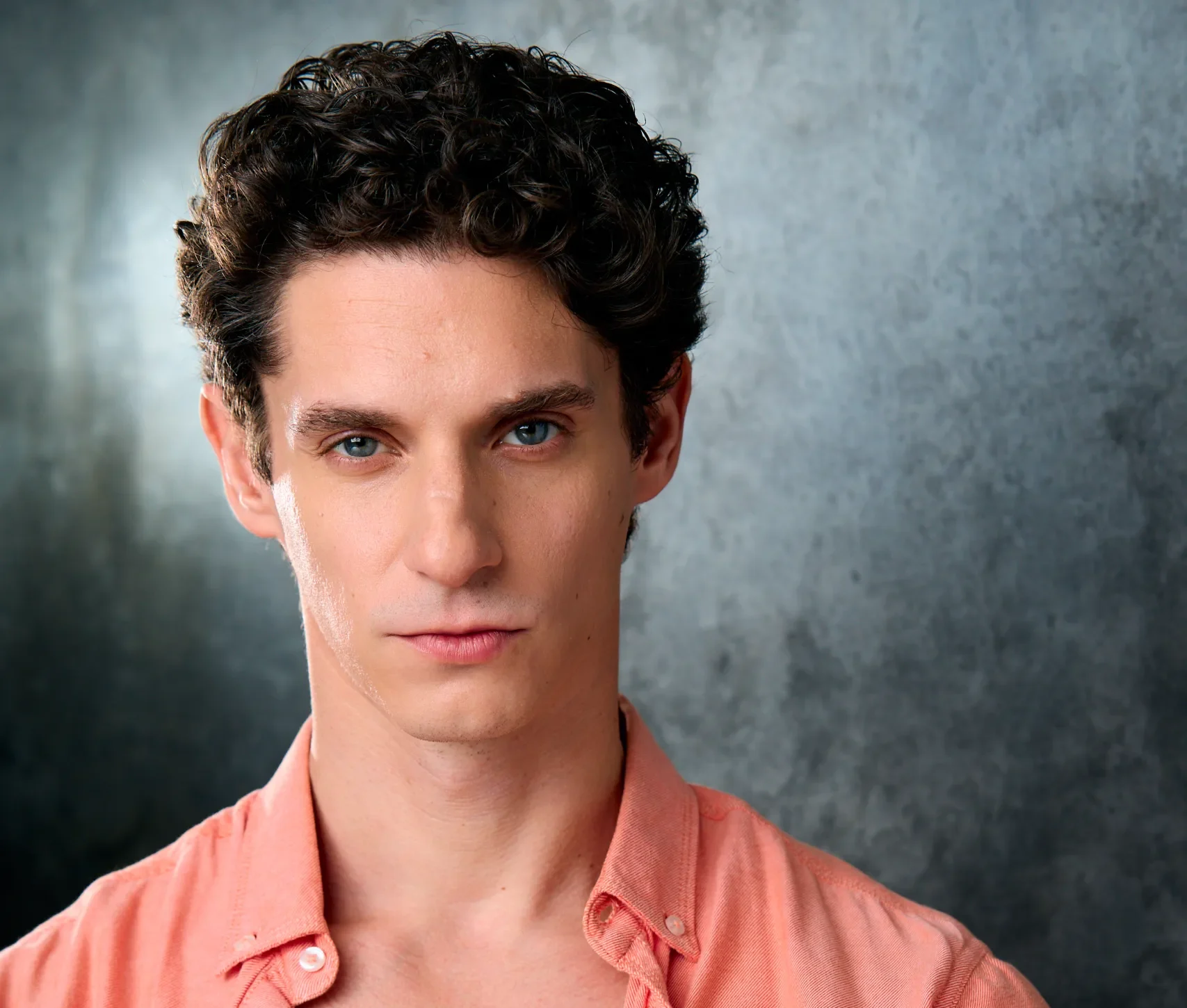

We are here today with an exceptional actor, Gabe Armentano, who has made waves in vertical drama and established himself as one of the most prominent figures in the industry. You know him as the villain James in My Accidental Alpha’s Desire, as the torn Senator Markus in Hear My Love Again, and as the broken, unshaven survivor in The Betrayed and Abandoned Son of Ashford. Along the way, he has also played plenty of the brooding CEOs that became his calling card.
His story didn’t start under studio lights. It started with a school musical his mother made him do at eleven. He bombed the audition and ended up in the ensemble as white chess piece #5 in Alice in Wonderland, and he loved every second of it. Years later, he moved to Los Angeles to work in TV and wanted nothing to do with “some weird web series.” Then casting director Stacy Chu kept asking until he said yes, and he hasn’t looked back.
In this conversation with BODONY, Gabe looks back on campfires and cousins, the beard glued to his face for Oliver!, and the one-take reality of shooting verticals. He also talks about the woman he met on set in China and married this May. He’s honest, curious, and a little philosophical, and he’s clearly still the kid with the most questions in the room.
Let’s take a step back into your early years. How was your childhood growing up? Are there any memories, stories, or moments from that time that shaped you and that you’d love to share with the fans, anything you think they would be interested to learn about the boy you once were?
Gabe: I look back on my childhood in a positive light. Movie nights, family trips, holidays with packed rooms and fully bellies. I was nothing short of blessed. I think the memories I look back on most fondly include our “Armentano Family Picnics” (They were like family reunions) or the occasional camping trip. We would pack up for the weekend, popup trailers in tow, and we would go to recreational campgrounds in groups upwards to five families at a time. S’mores, fishing, pools, and the smell of crisp leaves and burning firewood are really ingrained into my mind. I always felt these trips were more or less humble and affordable middle class family trips, but the older I get, I wouldn’t trade them for anything. Me and all my cousins really grew up together on these trips and I miss them. I want to recreate those trips for my future kids some day. I think a lot of people would appreciate that I was (and still am), a pretty curious kid. I always had the most questions in class, and it drove my teachers and peers nuts. But it also really taught me how to think for myself. Admittedly, I have to work through a psychological reflex to devils advocate/disagree with my friends and family in common conversation, but it’s not because I disagree with them; it’s because I’m constantly seeking to understand other viewpoints. Kind of like a piece of putty in my hand that I’m just constantly rotating, squeezing, working on, and mulling over. If I ever come off as opinionated, please know that it’s more my desire to speak up on an opposing viewpoint that may be misunderstood, but doesn’t necessarily belong to me. Which I find very helpful as an actor, especially one who is consistently playing roles that dance on both sides of ethical behavior.
Imagine for a moment that you’re face to face with your 10-year-old self, that young version of you who was still discovering the world and his own dreams. What would you say to him now, with everything you’ve experienced and the success you’ve built? What message, reassurance, or wisdom would you want him to hear from the man you’ve become?
Gabe: I would say “You are capable of anything, so be careful of what you practice.” The older I get, it’s just clear to me that we are the living manifestation of our habits. Our choices, our thoughts, they all are reinforced and expressed through us. We can be the hands and feet of God, or we can simply be an instrument for our most base desires, but the more you make and repeat these choices, the harder it is to change the course of who you become. If you want to be a leader, you must step into leadership positions. If you want to be a musician, you must play an instrument. And if you don’t want to engage in a certain negative behaviors all the time, then you better stop doing those behaviors asap. No matter how difficult you think it is to stop. I would also say, “It doesn’t get easier, but it gets more rewarding.” The work never stops, but boy do I cherish every holiday I have with my family, every phone call with my parents, each character I get to play, and every story I get to share. And from a very personal place I would say, “I know you think you’ve lost something, but just wait and see what you will find. Hold on, because it will be worth it.”
Gabe, what does success truly mean to you? Is it defined by career milestones, personal growth, the impact you leave on others, or something entirely different?
Gabe: For a long time I defined success as financial freedom, but now I think it’s more about freedom to do what I want to do with my own time. Financial freedom can buy you that, but if you’re sources of income are golden handcuffs, then it doesn’t matter how much money you make, no matter what, your time doesn’t really belong to you. I want the freedom to see my family during the holidays without asking for time off. I want the freedom to go on a trip with my wife, and not think about whether that will interfere with an upcoming job. Or even the freedom to just invest my own time into art and community. A script I want to write, a group I want to organize, a song I want to compose, and many other ways that I express myself or bring people together will always be limited not by how much money I have, but whether or not my time belongs to me.

You’re now a well-known actor in vertical world, Gabe. When did you first discover your talent for acting? Was it something you felt as a child, something that grew with you over time, or did it arrive later, once you were old enough to truly understand what acting meant to you?
Gabe: I don’t think deciding to be an actor was so much me discovering my talent for it, as my interest. I find talent to be a pretty unsatisfying metric to determine what I do with my time. But how I’m inspired, what creatively energizes me? I discovered this in middle school. I think I was old enough that I had a lot of other interests at the time, and so it felt like it “arrived later”. But the truth of the matter is 11 years old is still pretty young. My mom forced me to do a school musical. I bombed the audition, and was placed in the ensemble. And I loved it. I danced my ass off as white chess piece #5 in Oxford Center School’s rendition of “Alice in Wonderland”. I haven’t turned back since.
Did your acting journey begin with school plays, or did it come later on more professional sets? When and where did you first experience acting, and how did it make you feel stepping into that world for the very first time?
Gabe: School. School school school. My family couldn’t afford anything like acting classes, and we had no idea that something like an agent existed for professional work. So it was like a serious pursuit of fun while growing up. I think my first time getting lost in a character was the role of “Fagan” in the musical “Oliver!”. They glued a beard to my face, and I played an old streetwise trickster who sort of collected orphans to bring him money. And at that age, I was still head and shoulders above some of the other students, so when the lights came up, people couldn’t tell if I was a student or some random parent underneath all the makeup and costume. The audience seemed to enjoy how much nuance and play I brought to my character, and I think it encouraged the other students to give it their best performance too. I felt alive. Confident. I felt like a leader in the community. I felt inspired, and that I could inspire others. And that’s a liberating and empowering feeling.
Now let’s jump into one of my favorite topics: vertical dramas. How did you first discover this format, and what were your initial thoughts when you stepped into that fast-paced world of storytelling?
Gabe: The first time I discovered it was probably back in 23/24 when I saw the cheesy/creepy breakdowns of wolfs and CEO’s, and I immediately rejected it. I moved to LA to work on TV, not do some weird web series (at the time, the auditions were listed as web series or internet projects, not verticals, and I just didn’t have any interest). But eventually I was sort of forced into it. I met Stacy Chu on set of a modeling gig, she told me to audition for one she was casting, and I politely declined. But after her being super persistent, I caved, auditioned, and was eventually cast as James, the Villain across from Nicole Mattox in “My Accidental Alphas’s Desire”. And then it sort of clicked. I was the newby on set, everyone else had done a few, and continued to do them cause they were making friends, practicing their craft, and paying the bills. And for the first time in my life, I really saw a chance to do that. It felt kinda like a secret club at the time. Now it seems the secret is out haha
What was the first role you landed in the vertical-drama format, and how did it feel stepping into a world where everything moves so quickly, with entire projects often shot and wrapped in just 7 to 10 days?
Gabe: I realized pretty fast while playing James on set for MAAD that this wasn’t a typical acting gig. It wasn’t a play where you had weeks or months to prepare. It wasn’t TV where you had to be word perfect on your dialogue. And it wasn’t quite film where you could work through each scene with a healthy amount of takes. There was no time for any of that. And I loved it. I enjoy writing, improvising in character, brainstorming scripts and lyrics, and performing in Verticals allows me to use all those different parts of my brain. When I step on set and the scene isn’t working, or the dialogue feels clunky, I can pitch an idea to the director/writer/producer and we can try it on the spot. Sometimes it works, sometimes it doesn’t. But if we got at least 1 take that’s in the script, then we might able to get one take of a “fix” I made. A new juicy line, adjusted blocking, something that may elevate the moment beyond what was originally written. And then you move on. 4 takes is generous, three takes is appreciated, 2 takes is standard, and 1 take is the minimum. And often enough, there’s only time for the minimum, so you better make it count.

Out of all the projects you’ve been part of so far, is there one role or character that resonated with you most deeply, someone who stayed with you long after the cameras stopped rolling?
Gabe: Senator Markus in “Hear My Love Again”, was a treat to play. There was so much drama, sometimes grounded, sometimes not, but that team really challenged me to act my pants off. Markus was so conflicted between family obligations, career aspirations, and love, there were times that I felt the way Markus was being torn in so many directions in a personal way. Beyond the job of simply portraying his experience. And when you’re tapping into that feeling, it elevates the whole experience of acting.
Your role in The Betrayed and Abandoned Son of Ashford marked a shift from the characters audiences had seen you play before. How did it feel to inhabit a morally grey character, and what did that experience unlock for you creatively?
Gabe: This is gonna sound silly. But I haven’t changed my look since I was a kid. Like my wife recently shaved her head, and I’m low-key jealous because I want to do something new with my look. But I can’t cause I most often get work as a sort of “brooding or niceguy” type who’s a “young professional”. But in Son of Ashford, I got to step out of that that for a little. I can’t grow facial hair to save my life, but since my character was in prison for years, the creative team didn’t want my typical refined look of a CEO. They wanted something that was a bit more tired and broken. So two weeks before shooting, I squeezed out whatever whiskers my face could produce, and that experience actually fueled the character. My face was unshaven, my hair was long and curly, and these physical changes actually helped me live in a character that feels different from the so-called CEO Archetype I have so often filled for verticals. And I really enjoy that. Physical transformations, no matter how big or small, can always fuel the inspiration behind a character. As for the morally grey part, I love it. Some of my favorite movies fall into the genre of noir, in which no one is quite who they say they are. Meanwhile, I always find myself playing villains and heroes in Verticals, so Son of Ashford allowed me to really live in both. My character was put through so many dark scenarios, so much abuse, it was an exercise in seeing how much pain one person could endure until they want to check out of this world.
What would your dream role be, whether in a vertical drama or a full-length film, and what kind of story or character do you hope to bring to life one day?
Gabe: Either a Western or a Thriller. I just adore the American west, and whether I got to play a cowboy or an oil baron, I want to wear those period costumes, and inhabit that 19th century world. As for the thriller, the so-called “charming killer” would be an interesting archetype for me to fill; someone who just keeps getting away with murder, and is fueled by a vendetta or a manifesto. Add some heavy contrast and shadows, call it a Neo-noir, and I’m down to clown.
What does love mean to you today, and how has your understanding of it evolved as you’ve grown both personally and professionally?
Gabe: Love is a verb. I think some people really see it as a noun, a thing they can capture, hold onto, or preserve, but i think if love was simply a feeling or state of mind, it’s ultimately pretty empty. But when you consider love is a verb, in motion, and evolving at all times? That’s when I feel it’s real. When you want to love someone, add an -ing word to describe that act of love: sacrificing, healing, fulfilling, serving, respecting, etc. You don’t simply receive love, you create it, and you give it. Not in a vacuum, but with your partner. And if you don’t have a partner, then it’s with your friends and family. We are creatures that are often convinced that we never have enough, but I can assure you that if we were willing to give one another love, we would be able to find enough of it too. When I was younger, I used to squeeze love. My vision of how a relationship should look, how we behave, what we do, would be strained and filtered into what I wanted it to be. Dont do that. It is not a noun, you do not own love, any more than you own the person you love. You need to let go, and allow the love to evolve with time. People change over time, and so love intrinsically changes too. Believe me, it’s hard to let go, but once you stop forcing it, you’ll find that you’re not falling into old habits, you’re not reliving past traumas, you’re not avoiding unwritten future anxieties; instead, you’ll be experiencing a unique, fulfilling, and mindfully present love.

Since we’re speaking about matters of the heart, and knowing how curious fans can be, has anyone managed to steal your heart off-screen, Gabe? Or is love something you’re letting unfold gently in its own time?
Gabe: Oh yeah haha I got married May 12th 2026 to the love of my life, Ani Nozadze. And I can assure you our love is not gently unfolding anywhere. We met each other in China while working on a vertical in spring 2025, and over the following year, I knew that I met a woman who would stand by my side through everything. We not only shared a powerful and reciprocating love and desire for one another, but we share a vision for our lives together. A vision that is filled with art, family, community, and God. I’m so locked in, I love Ani with everything my body and soul contains.
When you look ten years into the future, Gabe, where do you see yourself, both in your career and in the life you hope to be living?
Gabe: The year is 2036. Ani and I have established careers beyond the Microdrama space as actors, writers and producers. We’ve even directed a few films, and produced an album we wrote and sang together. We have two kids, we travel between the U.S. and the country of Georgia to see both of our families, and we have a collection of magnets on our fridge that has at least 50 countries we’ve been to across the world. On Friday nights we have movie night with our kids, and on Saturday mornings, we wake up and drink tea together. Sunday mornings we’ll go to church as a family, and Sunday night we’ll host a board game night with so much Georgia Cheese on our charcuterie board, everyone will think we’re being unreasonable. But we’re not. Because on Monday, we’re gonna get right back to it, working hard, creating art, and continuing to build a community filled with color and love.
To conclude, what message would you like to share with your fans, the people who believe in you, and the friends who’ve stood by you throughout your journey?
Gabe: Say yes more than you say no. Ask for help even when you think you can do it on your own. Smile at strangers. Get serious about the work, but not too serious about yourself. There’s always room for growth. Question everything from your values and your dreams, to how you hold a pencil. You’ll be surprised to find out what really matters to you. Maybe you’ll discover a new dream. Maybe you’ll discover you’re ambidextrous. Maybe you’ll discover you like things just the way they are.
If there’s a thread running through Gabe Armentano’s story, it’s practice. He says we become what we repeat, and his career proves it: the musicals that cost his family nothing, the sets where one take had to count, the roles that “dance on both sides of ethical behavior.” He doesn’t measure success in money anymore. He measures it in time, and in whether that time really belongs to him.
That vision is already taking shape. He’s married to Ani Nozadze, the woman who will “stand by my side through everything.” He pictures a life split between the U.S. and Georgia, Friday movie nights, Saturday tea, Sunday church, and a charcuterie board “with so much Georgia Cheese… everyone will think we’re being unreasonable.” Then on Monday, it’s back to work.
His advice to his fans sounds like the way he lives: “Say yes more than you say no.” Ask for help. Smile at strangers. Take the work seriously, but not yourself. And question everything, from your values and your dreams to how you hold a pencil. You might discover a new dream. Or, as Gabe puts it, you might just discover you’re ambidextrous.


Gabe Armentano’s Social Media:

Written by Engjell Hasula
Independent writer and interviewer. Editor of BODONY, an independent editorial featuring conversations and portraits of artists across creative industries.
Follow Buy me a coffee


Wow! What an amazing interview. Gabe is someone I would love to sit down and have dinner with. His honesty and openness was heartwarming. Well done!!!