
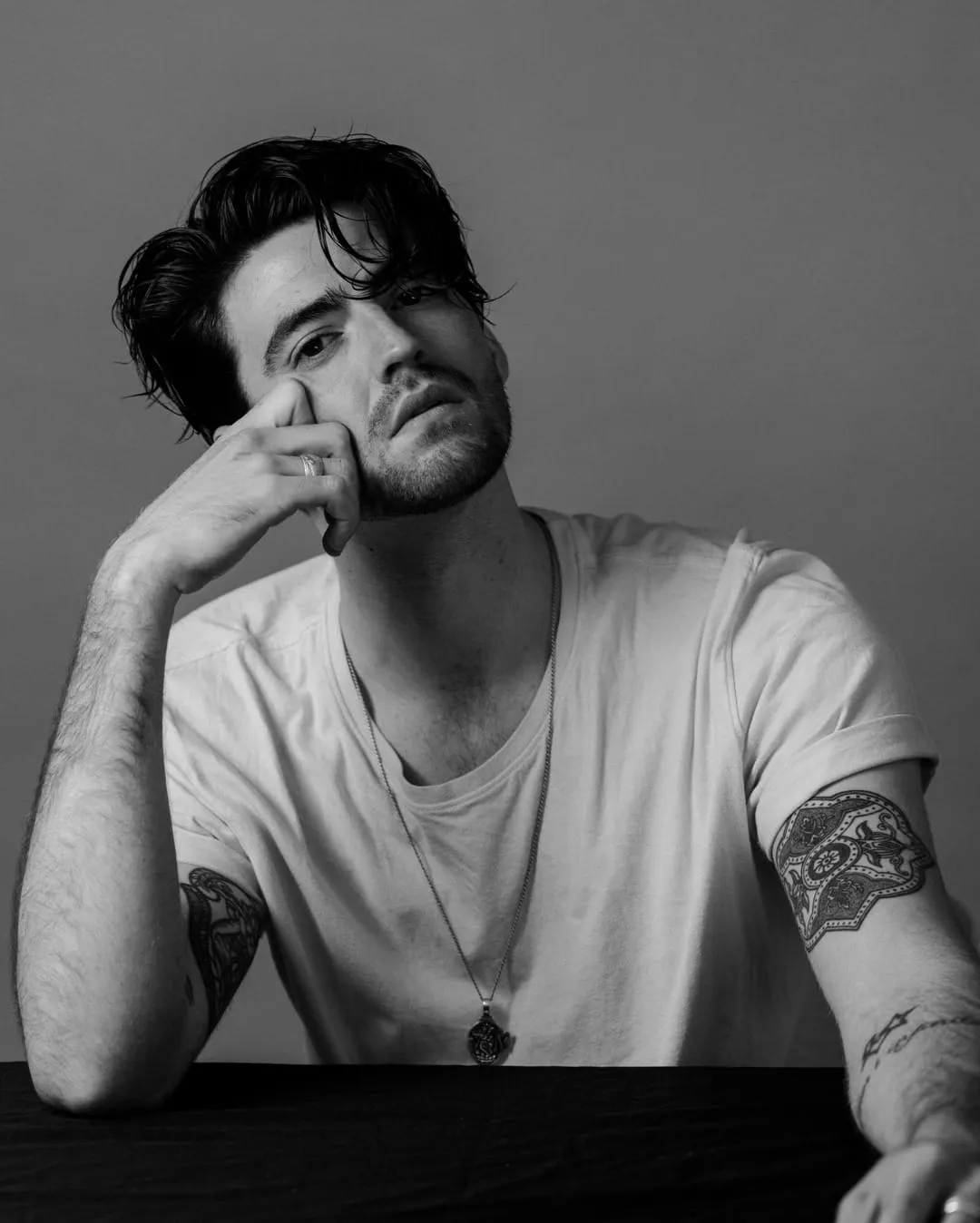


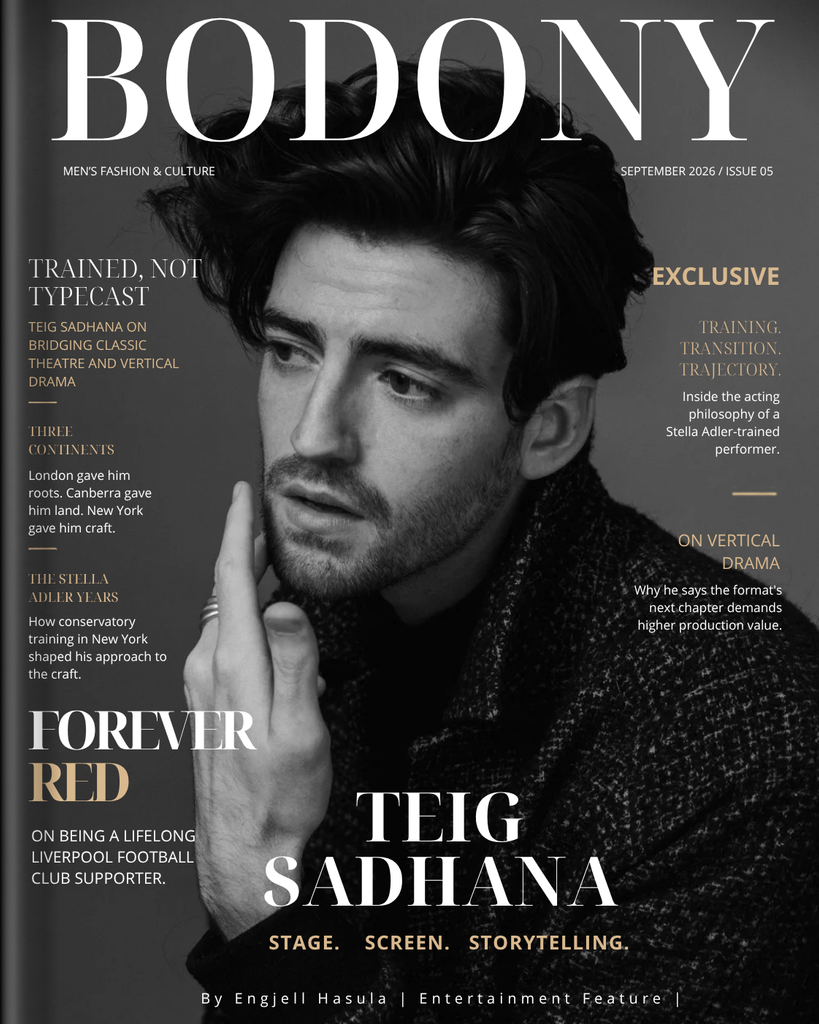
Dear readers, every so often, we meet an artist whose presence lingers long after the curtain falls or the screen fades to black. I had the privilege of sitting down with one of those rare individuals, a man whose talent spans from the intimacy of the theatre stage to the immediacy of the vertical drama format. The sensational Teig Sadhana is not only an exceptional actor but also a good friend, someone whose dedication to his craft is matched only by his generosity of spirit.
From his commanding performances in classic theatre to his trailblazing work in vertical dramas that have captivated audiences worldwide, Teig embodies the kind of artistry that inspires both peers and fans alike. In our conversation, he opened up about his journey, his passions, and the experiences that shaped him, offering a glimpse not just into the actor, but into the thoughtful, remarkable person behind the roles.
1.You were born in London and raised in Australia, can you tell me a bit about your childhood, and how moving countries at a young age shaped who you are today?
Teig: You know what they say about the first five years being instrumental in developing who you are as a person? I really feel that sometimes. My first five years of life were moving between continents, my parents uplifting our family from where we lived in North London and settling us into Canberra in Australia. And I think about that now as an adult, having moved and lived in three different continents now in my adult life alone. And I can’t help but feel like it must have had some effect. I am always fascinated by the concept of sharing culture, of sharing experience across country borders and lines. I’ve always been super interested in the sameness of people. I think I got that from having these broad family connections all across the globe. As for how that’s really shaped me now, I think it means that I look for that sameness still in everyone. In my happiest moments, in my darkest moments with other people, I’m always looking for the sameness. I’m looking for myself within them. And I find that leads to compassion and a deeper connection to myself, to other people, and to the world around me.
2. Growing up on Ngunnawal country, what influences from that environment, cultural, family, community, have stayed with you?
Teig: In Australia, the land is incredibly important. I was fortunate enough to grow up on Ngunnawal country, which is the lands of the Ngunnawal people in southeast Australia around Canberra, what is now the ACT. I have always felt a deep love for that land. That land feels like it raised me in lots of ways. And I had the privilege of that relationship with the land without having the blessing of even being born there. So for me, that’s certainly what I think of when I think of my connection to life and my connection to culture, the land. It comes from feeling like I am held and accepted and invited by the land and space around me. With that often comes a sense of community and closeness to the people around you, your family, and any other people who share that same space, that same environment, those same landscapes.
3. When did you realise acting was something you wanted to pursue seriously? Was there a particular moment or role that clicked for you?
Teig: I took acting classes as a child, I think, one summer when my mum was trying to get me out of the house. And I really enjoyed it. I remember playing a dog in the play that we presented to the parents at the end of the program and really, really loving the process of feeling like a dog. And I think from there that kind of sparked something. But I never really took it seriously until I had a chance to move to America and study at the Stella Adler Studio of Acting. That was the first time where I made a direct effort to pursue acting and to pursue the lifestyle that an actor has to have.
4. You studied at the Stella Adler Studio of Acting in New York (Professional Conservatory). What drew you to Adler’s methodology, and how has that training influenced your approach to performance?
Teig: The philosophy behind the training at Stella Adler really connected with me and what I need as an artist to find inspiration, and to connect to the work that I’m doing. I think the most poignant part of it for me is understanding circumstance, and having empathy for reason, for that concept of given circumstance. To really live and understand them enough to bring a humanity to that. I didn’t write these plays, these verticals, these movies, and yet I have to give my humanity to it for it to work. And so in order to do that, you have to really connect and understand. And I think the way in that the Stella Adler technical training offered me has really helped me. I see acting at its highest form as a sort of prayer. It is deeply ingrained in us to tell stories, and therefore there is something holy in the process for me.
5. Who among your teachers or mentors at Adler had the most impact on your growth.? Can you share a lesson or piece of feedback you still carry with you?
Teig: The teacher that had the most profound effect on me was Ron Burrus. He taught technique to the students at Stella Adler. I think one of the standout moments that he left with me was in our first year — he was trying to explain to us what acting is at its purest form. He likened it to the sun and the moon. And he boiled it down to the idea that you cannot be the sun. The script is calling for the sun. You cannot truly be the sun no matter how hard you try. But, in the same way that the moon does not illuminate light by itself, it reflects the sun’s light and we still see it. And the light is still there. He emphasised that THAT is what acting is. Be that light. That really stuck with me.
6. How did your time in Adler’s Rehearsal Room and the broader conservatory environment challenge you or change your understanding of acting?
Teig: My time at Stella Adler made me a far faster, better, more competent actor, and it made me question and investigate my artistic voice in a way that has strengthened me and aided me in my approach to my work now as a professional actor in the industry.
7. You’ve produced festival-recognised short films (e.g. A Lonely Harvest, Claymates). What drives you to write/produce your own short films, as opposed to only performing in others’?
Teig: I’ve always felt a drive to cultivate my own work not only to sustain myself as an actor trying to live the life of every other person and pay my rent, and keep up on bills, and eat healthily, but also to refine my own artistic voice. There is such pleasure in finding your voice in other people’s work. But when it is your own work, there is something more pure and intoxicating about that feeling. I feel closer to the prayer when I offer my own work like that.
8. Vertical dramas and micro-dramas are increasingly prominent, and you’re a recognised figure in that space. What are the unique challenges and opportunities of acting for vertical / micro-formats?
Teig: Verticals have given me an incredible opportunity to form a career for myself so fast and so early out of drama school. Verticals have been a huge challenge at times stylistically. They are specific in their approach to storytelling and as an actor, you must find a way to fit it properly. I have found there are certain technical elements to the vertical acting that help get a grip of things, such as strong gear shifts. As an actor, you must be fast and intelligent, and with verticals moving so quickly, this demand is even higher in making vertical movies.
9. You played Brick in Cat on a Hot Tin Roof (Canberra Repertory). What was it like to take on such a demanding, classic role, and how did you prepare for that?
Teig: Playing brick in Cat on a Hot tin Roof was one of the greatest acting challenges I’ve had so far. There is such presence in that character throughout the entire play. And yet, in the script, his lines and dialogue are at times rather minimal. So to carry humanity with you, strongly, and to resonate that presence across a stage out into a room in a way that is alive and active is a genuine challenge. But within that challenge is a golden learning opportunity that I took because there is a reason for brick to be so sullen. There is a reason brick uses his words choice, uses his words specifically. There is a psychological rhythm to his presence that must build and strain and ultimately peak in order to unleash him into the crucial action of the play. There is an inner life that he has that is burning in him. And as an actor, it is such a joy to learn the lesson of the importance of that within every character you will go on to play through finding it within a classic character like Tennessee William’s Brick.
10. What motivated your move to New York, and what were the biggest surprises (good or difficult) when you started working there?
Teig: When I decided to move to New York, I was living in London and working as a barista and knew that there was more that I could pursue. I saw auditions for Stella Adler, and I recorded my tape. And when I got in, the drive to come to America was mainly due to the immense film literacy of the industry here. There has always been a deep cultural tradition of filmmaking in this country and that excited me. What surprised me when I moved here was the size of the culture. American culture is wonderfully colourful and expressive and it has been a joy to experience that so authentically by living my life here and taking the beautiful opportunities it has provided me.
11. Tell me about your love for football, especially Liverpool. What does being a fan mean to you, and does it ever influence your work or outlook? (E.g., discipline, teamwork, perseverance.)
Teig: Football for me is a huge stress relief and escape. I find watching it like watching wizard’s chess or something. You have these eleven guys passing around this little ball of air to try and unlock a way through another set of eleven guys. And I find it fascinating every single week. Liverpool Football Club has always been a sense of home attached to it for me. That football club represents a love and devotion and authentic poetry that no other football club has. So they have my heart forever.
12. Outside acting, what are some other creative passions / outlets you pursue? (Music, writing, etc.) I saw you have some musical credentials.
Teig: Outside of acting, I play music a lot and I also taught myself to sculpt. When I was in the height of drama school, I needed to find a way to relearn how my brain learns. So I found the most tactile thing that I could. Clay. I have since become quite good at sculpting scenes and characters, and I really enjoy it when I have the time to fully devote myself to the craft.
13. You often share spiritual thoughts and stories online. Can you tell us how your beliefs have shaped or changed your life, both personally and professionally?
Teig: I have a profound connection with what I believe to be God. I have an awe towards that energy and even that word. For me, it manifests in my life as the charming, dancing, flute playing Sri Krishna. The dialogue I have with God has offered me the energy and the battery to truly pursue my life, to be an active participant in the poetry of my life. The more I am in dialogue with God, which is my life, the better my life runs, the better I operate, and the greater the opportunities that God provides me. God also gives me an infinite pool of love for myself and other beings, both human and otherwise, without that tether, it can be cold sometimes in this world, and I seek to sit in warmth that God provides me.
14. Where do you see yourself in 5–10 years in terms of your career trajectory (stage, film, directing, writing)?
Teig: In 5 to 10 years I have quite a simple wish. I want to be standing on a film set. I want to look left and see my friends. I want to look right and see my friends. I want to look dead ahead of me and see a beautiful scene ready to take place. And then I want to call action. I hope to bring all the people I love together and into the success that I am making with my career. I hope that other people I meet along the way do that for me and pull me into theirs. This collaborative art form has built such a beautiful community already in my life. In five to ten years, if I have taken more steps forward with that community, if I have developed an even stronger backbone in our industry as an established artist, I will be happy.
Within saying that, I have always yearned to keep my bar low. To be totally honest, it would serve me well if I just woke up every morning and looked forward to the day ahead of me. If that’s all I have in five to 10 years, I think I would be happy with that.
15. Are there particular roles, stories, or types of characters you’ve yet to play but very much want to?
Teig: I would love to see what more complex and interesting vertical lead characters are on the horizon. I know myself and my writing partners are working tirelessly to bring interesting new stories to the vertical scene. However, I’m also really intrigued by what others in the industry have in mind. I am looking forward to seeing these characters develop, and these stories strengthen as we take this industry forward.
16. With the rise of new formats (vertical, micro-drama, streaming), how do you think the industry will evolve, and how are you preparing for that future?
Teig: What we have created here so far is tremendous, from the community of fans eagerly awaiting everything every new release, to the brilliant bubble of creatives across the world who are making these regularly. It is a pleasure to be a part of this new frontier of filmmaking. To go forward, I think a deepening of the stories, and a further emphasis on on character development and layering will make these films excel even further. I also believe it is time we bring in higher quality production. As the production value for these films goes up, each film looking and feeling more and more like the standard of film and television expected in countries so film literate as the United States, more attention and money is attracted to the space. The better the standard of the products, the faster this industry will truly legitimize itself and bring in the new ideas and major investors and industry heavy-hitters to help us capitalize on just how wonderful it is what we’ve got here.
Dear readers, we came to the end of this beautiful, unfiltered interview. Having time with talented people and good friends is truly priceless, and speaking with Teig reminded me why conversations like these matter so deeply. Teig Sadhana’s journey is only at its beginning, yet the horizon already sparkles with promise. From his roots in theatre to his fearless embrace of the vertical drama revolution, he has proven that storytelling is not just performance, but a profound connection between artist and audience. If you want to feel the rawness of real emotion, to be swept into stories that make you laugh, ache, and fall in love, then I invite you to witness the greatness he is becoming. Teig is not simply an actor, he is a force shaping the future of storytelling, and this is just the start of his remarkable path.