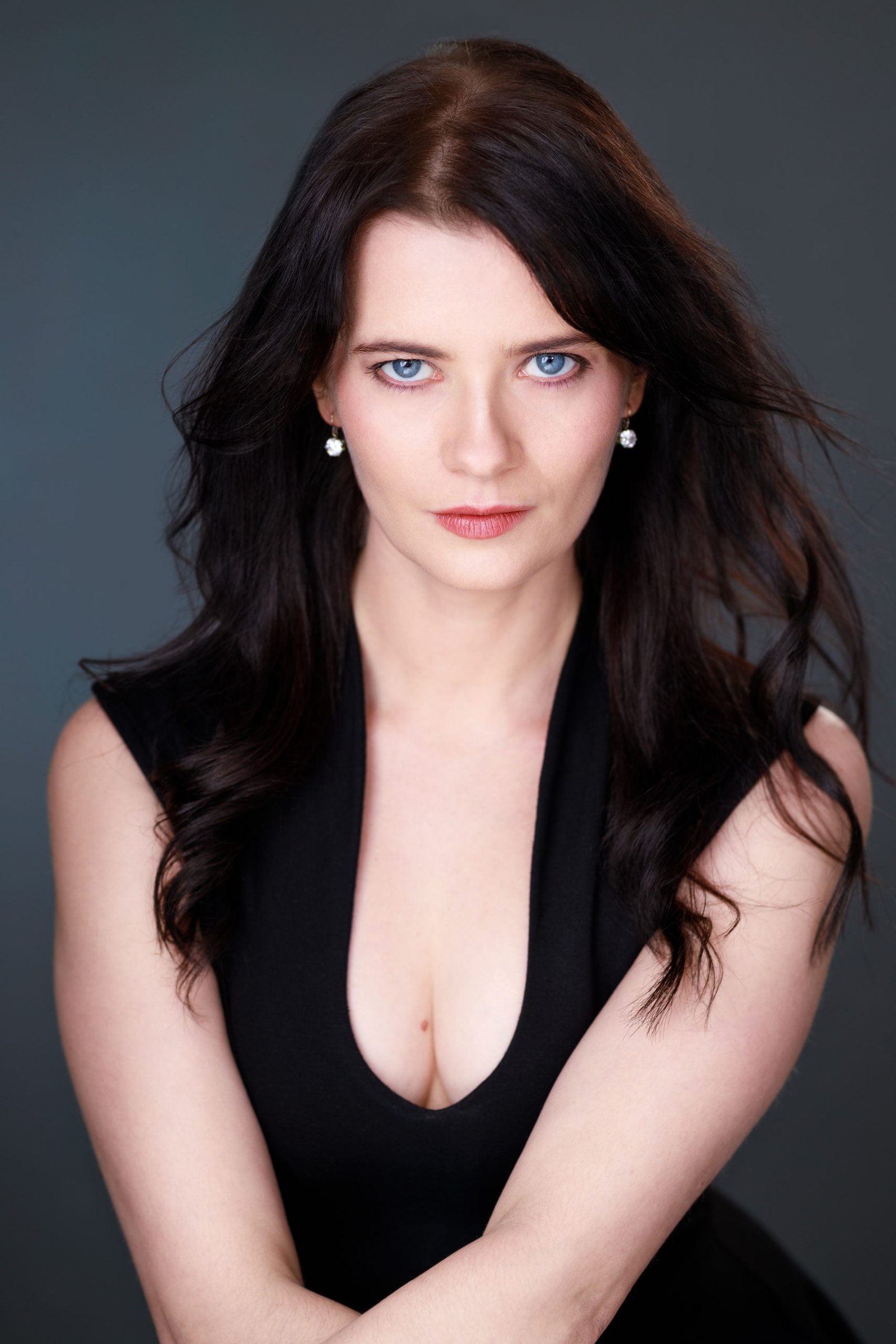

Julie Bruns spent her childhood in motion, seven years in Baja California, and a string of other stops before and after, carrying Lord of the Rings and Pirates of the Caribbean with her wherever she landed, reciting them word for word. That story-hungry kid grew into an actor trained at LAMDA under Larry Moss and Anthony Meindl, who has since played everyone from Ada Lovelace to a cursed-map-chasing pirate captain, and who writes, directs, and produces alongside acting.
Before she ever wrote a vertical drama, Bruns starred in twenty-five of them, an apprenticeship that taught her the format from the inside out. That groundwork became Beneath Crimson Sails, the indie pirate vertical she wrote, produced, and stars in as Catherine, working alongside her longtime creative partner Steven Kammerer. It premiered to a sold-out, sword-fighting, mermaid-heralded crowd at the Rio Theatre, where the audience shouted “kiss already” into the cliffhangers like it was Rocky Horror for the vertical age.
We sat down with Julie to talk horseback riding and Breyer models, the LAMDA lesson she still lives by, bringing Ada Lovelace to the screen, and why she thinks the format deserves the same respect as any frame.
Every journey starts somewhere Julie, often in childhood. For our readers who are just discovering you, can you take us back to those early years? What was your childhood like, and is there a memory or small story that still stays with you today? Were you a shy child, or more on the mischievous side?
Julie: My family traveled a lot when I was younger, so I ended up growing up all over. The longest I ever was in one place for as a kid was actually for 7 years in Baja California, Mexico! I think the constant moving was one of the things that really sparked my love of film, too. No matter where I was, my favourite stories, worlds, characters would come with me. Lord of the Rings, Pirates of the Caribbean, I had films that I could just recite the whole thing back, word for word.
I was a bit of quiet child, but not necessarily shy… just swept up in my own inner worlds.
How was life for you growing up? Before discovering acting as your true calling, were there any hobbies, interests, or activities you explored that helped shape who you are today?
Julie: I was always reading, especially fantasy books, and I definitely had a busy imagination, always finding various creative outlets. I remember my first early forays into filmmaking with my mum running the camcorder while I puppeteered my Breyer model horses. So yeah, both a horse girl and a filmmaker from early years. And anytime I could actually go horseback riding, that was my best day ever.
And to this day, horseback riding, archery, swordplay, I love it all.

Now that you’ve grown and carry your own experiences on your shoulders, if you could sit down with your ten-year-old self for a moment, what would you tell her? What words of comfort, courage, or hope would you offer that younger version of you?
Julie: It doesn’t have to be perfect, let go, have more fun, you’re allowed to make a mess. The mess is where you find yourself sometimes.
You trained at LAMDA and worked under mentors like Larry Moss and Anthony Meindl. What’s a piece of advice from that training you still carry into every role?
Julie: There are so many facets and tools and inspirations that I carry, and every role asks for a little something different. One of my favourites though, that I still quote all the time was from Tom Todoroff, who would repeatedly say “How you do one thing is how you do everything.”
For me that care that you take of yourself, that you take of the rehearsal and the study of the character, all of those pieces of the work, they are the work. How you play the role is inherently tied to how you’ve prepared the role, and to go even wider, to how you live life.
You’ve worked as an actor, writer, director, and producer. Do you approach a project differently depending on which hat you’re wearing that day, or does one instinct drive all four?
Julie: There’s a creative vision that runs through and connects everything for sure, but I think it’s important to get to just do one job at a time sometimes. If you’re immersed in a scene as an actor, you don’t want a producer voice in the back of your brain worried about how long you have the location. You don’t want to be questioning the words you wrote while your character is supposed to be living them. It’s important to me to be able to switch that off while I’m acting. That’s my time to really do the character justice.
And I’ve been lucky to get to work with my partner, Steven Kammerer, directing so often, because we’ve worked together so much now and have such an intuitive shorthand on set, it’s easy to let go and knowing he’s got everything handled, so I can focus on acting.
Playing Ada Lovelace and co-writing that project clearly meant something beyond just a role, what did it feel like to bring her story to a modern audience?
Julie: Ada is absolutely a figure that should be far more well-known than she is, even now. Getting to bring her story to the screen was an honour. I think it’s so important to know how women like Ada Lovelace have been trailblazing in STEM fields since the very beginning, especially for girls and young women who want to work those areas.
You’d already done 25 vertical dramas before creating your own, what did that apprenticeship teach you about the format that you couldn’t have learned anywhere else?
Julie: Getting to act in so many verticals before taking on the challenge of making one was absolutely a unique advantage.
It allowed me to read so many scripts and be on so many sets, see what was working, what could go smoother, how to do so much with few resources. Even now, when I’m on traditional film and television sets as well, I feel like I’ve discovered such a rhythm of efficiency that comes from vertical filmmaking. I can’t wait to take some of those lessons and apply them to other forms of filmmaking as well.

What was the actual spark for Beneath Crimson Sails, was it really just fans online calling for a pirate-themed vertical, or had that idea been sitting with you longer?
Julie: Pirates of the Caribbean was one of my favourite films when it came out, and The Princess Bride was just perpetually on repeat when I was a kid. Becoming a pirate was definitely the dream from about age 7 to 13.
Making a film that is all ships and stunts and period-set costumes is an intimidating challenge even if you have money and time and resources. Doing a vertical, let alone an indie vertical, you have none of that, so a pirate-themed show seemed wild. But I’ve always loved a challenge, and I was working with an amazing team on another fantasy project right around when the fans started talking about a pirate vertical. I remember being on set with half the team we ended up working with, already in fantasy costumes, and we just started musing about how fun it would be to be pirates, and then Reg said the magic words: “I know someone with a boat”, and bam! Off we went.
That’s the trouble with actors, they’ll just “yes, and” right into making a pirate vertical.
Writing, starring in, and producing the same project is a lot of pressure to carry at once. Where did you have to let go of control, and where did you refuse to?
Julie: So much has to happen for any project to make it to the screen, that it feels like a miracle anytime anything gets made. I think I just focused on putting one foot in front of the other and hoped that the right pieces would align.
We had a lot of days where the weather was supposed to be horrible, but we couldn’t move the schedule, so went ahead anyway, and ended up with mostly great filming days. I took that as a good sign from the universe.
I think such a huge part of filmmaking is having amazing people on the team who you trust to bring their artistry to it. A film becomes what it is because of everyone’s touch, it’s like painting a picture together, all holding the same brush.
I wanted to make something where people could get lost in a fantasy pirate world, with hints of nostalgia from their favourite childhood fantasy shows. I wanted a set where the cast and crew had fun, and were safe and respected. And I wanted to make a badass fantasy vertical without f*cking AI. (can I swear in here? 🙂

Catherine is described as fiercely independent, chasing down a cursed map to avenge her father. How much of yourself did you write into her?
I’d like to think her resilience and her wit are similar to mine. She’s definitely a bit more impulsive than I am, but that’s a pirate for you.
You’ve said there’s space for indie filmmakers in vertical drama, but the genre is still dominated by werewolves, billionaires, and forbidden alphas. What does it take for something original to actually break through?
Julie: The support for indie is key. Indie filmmakers can bring incredible fresh and unique storytelling to the space, but filmmaking is hard and expensive. In indie, you’re often taking time off your regular job to work 12-hour days on something just because you believe telling a great story is worth it. Knowing someone is watching, and enjoying sinking into the magic of a good story, and you’ve given them that little moment.
But filmmakers still have to be able to support themselves, and expecting filmmakers to carry the risk of making something on their own means not many will be able to do that. Those stories simply won’t get to be told. Audiences calling for these stories, and platforms putting money behind indie projects means more can be made. That filmmakers can pay rent and buy groceries while making the stories you love.
Great marketing as well, that allows a project to find the right audience is so important, especially if verticals are to keep growing.
The Rio Theatre screening had live swordfighting and a costume contest, a very analog celebration for a very digital format. What did that night tell you about where this genre is headed?
Julie: The Rio Theatre screening of Beneath Crimson Sails was one of the most fun screenings I think I’ve ever been to. Firstly, any screening that starts with swordfighting and a live mermaid is off on the right foot. But then we left the vertical episode breaks between each episode, so there were 2–3 second gaps after each cliffhanger, and the audience started calling out things like “Run!” and “Tell her!” and “Kiss already!”, and it started to get the energy and momentum of almost a Rocky Horror Picture Show screening.
The audience was absolutely part of the experience, and even for people who had never seen a vertical before, there was a sense of something special happening. Who knew the best way to watch a vertical could be theatrically?
If someone outside the industry still thinks of vertical drama as disposable content, what would you want them to understand about the craft that goes into a show like this?
Julie: The vertical format doesn’t make it less of a craft. We don’t look at portrait-oriented paintings in a museum and say, oh, it’s beautiful, but it’s a shame it’s vertical. The aspect ratio doesn’t change the quality. It’s a screen. It’s up to us what we put on it.
When you look ten years into the future Julie, where do you see yourself, both in your career and in the life you hope to be living?
Julie: I really hope I get to keep doing this. I can’t imagine not doing this.
I hope we’re in a world where we remember that the magic of art and film is the humanity in it, and the way it connects us, and reminds us that we have far more in common than we have differences.
To conclude, what message would you like to share with your fans, the people who believe in you, and the friends who’ve stood by you throughout your journey?
Julie: Always just an immense thank you. It’s absolutely a privilege to get to do this, and I couldn’t do it without them.
Ten years out, Bruns isn’t chasing anything new, just more of this. “I can’t imagine not doing this,” she says. It’s a fitting note from someone who’s spent her career arguing that format is no measure of craft: “The aspect ratio doesn’t change the quality,” she says. “It’s a screen. It’s up to us what we put on it.” To the fans and collaborators behind Beneath Crimson Sails and everything before it, her closing word is simple gratitude, “an immense thank you,” as she puts it. “It’s absolutely a privilege to get to do this, and I couldn’t do it without them.”