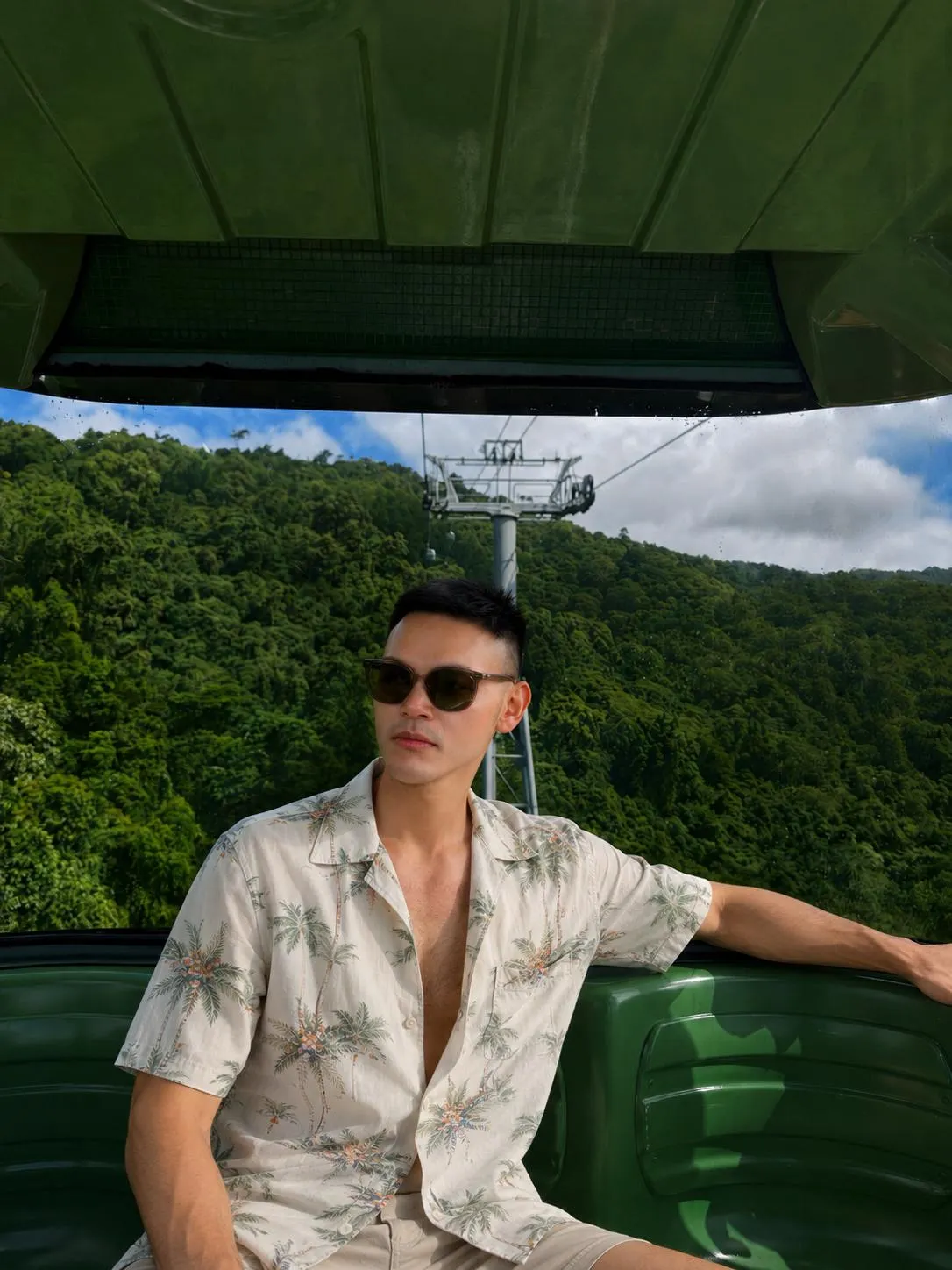

We are here today with Timothy Oh, General Manager at COL Group International, the company behind ReelShort and FlareFlow, and one of the sharpest voices shaping the vertical drama industry as it moves from novelty to structural shift. Before storytelling meant sixty-second episodes built for a phone screen, Oh’s path ran through documentary filmmaking for National Geographic and Discovery, artist management with regional stars and Hollywood names alike, studio marketing, radio, and gaming, an unusual route that, as he tells it, has always come back to one thing: the art of storytelling. Today he sits at the intersection of production, talent, marketing, technology and commercial strategy, deciding which stories get made, for whom, and where they travel next. But behind the industry read is a more personal one, a boy in Singapore who was once told, quite plainly, that he wouldn’t make it far. We sat down with Timothy to talk about vertical drama’s next chapter, the uneasy economics of loyalty in a mobile-first world, and what it looks like to finally make peace with the parts of yourself that never stopped being afraid.
Let’s take a step back into your early years. How was your childhood growing up? Are there any memories, stories, or moments from that time that shaped you and that you’d love to share with the fans, anything you think they would be interested to learn about the boy you once were?
Timothy: Growing up, I was often made to feel that I would never succeed. I was raised in Singapore in a Chinese family that spoke predominantly Mandarin at home. Although English was technically my first language, I struggled with it. People made fun of the way I spoke, saying my sentences sounded like a choo-choo train because they came out broken and in pieces.
One of the memories that stayed with me was overhearing a teacher tell my mother that I probably would not make it very far in life. I was very young, but I remember how deeply those words affected me. I was not doing well academically, I struggled to focus on subjects such as mathematics, and I began to believe that perhaps I really was destined to fail.
At the time, it felt as though there was only one route to success in Singapore: doing well academically. My family was not wealthy, so I did not have the financial safety net or confidence that I saw in some of my peers. Even when they did not perform well in school, they seemed secure because they knew they had other opportunities. I did not feel that way. I grew up believing that failure was simply not an option.
After finishing school and completing National Service, I desperately wanted to attend university. My grades were not strong enough for a local university, and I could not afford the kind of education I wanted overseas. I had to put that dream aside for almost ten years. When I was finally financially able to pursue it, I paid my tuition fees in full myself. I eventually graduated with first-class honours from one of the UK’s leading universities.
That experience shaped much of who I am today. The fear of failure stayed with me, but over time, I learned to turn it into determination. It made me work incredibly hard and taught me that you have to become the change you want to see in your own life. Complaining about your circumstances will not transform them. You have to put your heart and soul into building something different.
Sometimes, the people who come from the most difficult beginnings develop the strongest will to succeed. When you grow up believing that there is no safety net beneath you, you learn how to keep climbing. Looking back, the boy who once believed he would never amount to anything became the reason I refused to give up.
Imagine for a moment that you’re face to face with your 10-year-old self, that young version of you who was still discovering the world and his own dreams. What would you say to him now, with everything you’ve experienced and the success you’ve built? What message, reassurance, or wisdom would you want him to hear from the man you’ve become?
Timothy: This question makes me quite emotional because, if I were standing in front of my ten-year-old self, I think I would first want to hug him. I would see a boy who was frightened of failing, who desperately wanted to feel safe, and who believed he needed to prove his worth before he could be loved or accepted.
I would tell him, “You don’t have to be so scared.”
The truth is, even as an adult, I am still learning that lesson. I have spent so much of my life looking ahead, trying to build a future secure enough that nothing could hurt me again. But that kind of security does not really exist. Nothing is guaranteed, people and circumstances can change, and life can turn in directions we never expected. Constantly trying to protect yourself from the unknown can become its own kind of prison.
I would tell him that it is okay not to know what is coming. It is okay not to have all the answers. He does not need to figure out his entire life at ten years old, and he does not need to carry the weight of becoming someone successful just to prove that everyone who doubted him was wrong.

The future will come, and the past has already happened. The only thing we truly have is now. I wish I had learned earlier to treasure the people, the moments, and the ordinary days in front of me, because they pass much faster than we realise. There is nothing we can do to stop time, but we can choose not to let fear take so much of it away from us.
Most of all, I would tell that little boy: “You are going to survive things you cannot yet imagine, and you will become stronger than you believe. But you do not always have to be strong. You are already enough, even before the achievements, the titles, and the success. Please be kinder to yourself. Stop worrying so much about whether you will be okay one day, because you deserve to feel okay now.”
You started in filmmaking and factual programming before moving through artist management, studio marketing, radio, and gaming. What did each of those stops teach you that you still use at COL?M
Timothy: It is a great question because, looking back, everything comes together through one thing: the art of storytelling.
I started filmmaking when we still worked with film and tapes, and before everyone had a camera on their phone. Working on documentaries for National Geographic and Discovery taught me how to structure ideas and make stories captivating. Production also trained me to think one step ahead. Can we film here? Do we have the permits, contracts and clearances? I still approach business in exactly the same way.
Artist management taught me how to work with people, emotions and egos. I worked with everyone from regional celebrities to Hollywood stars, and learned that regardless of fame, beauty or wealth, everyone is human. Everyone wants to feel valued, and everyone is fighting battles we may not see.
Studio marketing taught me how to take stories international and make them connect across different markets. Radio taught me the power of music and discovery, but also how to let go of control and embrace the unexpected. Gaming taught me how mobile-first audiences behave, make decisions and build habits.
My role at COL now brings all of that together: storytelling, production, talent, marketing, technology and commercial strategy. It feels like a natural progression. To be very frank, that combination of experience is quite rare, and I am grateful that I now get to use all of it.
Was there a specific moment when you realized vertical drama wasn’t a fad but a structural shift in how people watch things?
Timothy: The moment was when I saw my mother watching a vertical drama on my tv. I was confused because I assumed it had been edited from a traditional long-form series. Then I realised she was actually watching an entirely new type of show.
My mother used to watch long-form soap operas, but TikTok and Instagram had changed the way she consumed content. If even she was embracing shorter, serialised storytelling, I knew this was much bigger than a trend. It reflected a fundamental change in audience behaviour, and I knew I needed to take it seriously.
The question is no longer whether vertical drama is a fad. Technology has made it possible for almost anyone to create content. The real question is who can consistently create quality content that audiences care about.
It is the same with YouTube. There may be thousands of creators and food reviewers, but the ones delivering real quality and value are the ones that last. Vertical drama will be no different.

You’ve said vertical drama “arrived when mobile behavior became the distribution layer” rather than as a new format, can you unpack what that means for someone outside the industry?
Timothy: I remember when we would sit in front of the television and give a programme our full attention. Today, people can be watching television while simultaneously scrolling through Instagram, Facebook or TikTok. Mobile has changed not only where we consume content, but also our attention spans and expectations.
Content is now more accessible, but it is also more disposable. In the past, we might continue watching a mediocre show simply because it was the prime-time programme and there were limited alternatives. Today, audiences have endless choices. If something does not capture their attention immediately, they move on.
So when I say mobile behaviour became the distribution layer, I mean that vertical drama was not simply a new format designed to fit a phone screen. It succeeded because it was built around how people now discover, watch, share and abandon content.
The format followed the behaviour. That is why it arrived at exactly the right time.
Vertical drama borrows more from mobile gaming economics than from streaming. What’s the trade-off in treating audiences like players instead of subscribers?
Timothy: There are similarities, but also one major difference: loyalty.
With a mobile game, once players invest their time and progress, they have a reason to keep returning. There may be a million versions of Candy Crush, but loyal players continue building within the game they have chosen.
Microdrama is different. Audiences are often loyal to an individual series, actor or story, but not necessarily to the platform. If an actor they like appears elsewhere, they simply follow them. We are effectively training audiences to move from platform to platform based on whatever captures their attention next.
The trade-off is that user acquisition becomes incredibly expensive while retention remains difficult. Platforms must constantly produce and market new shows, knowing that audiences may lose interest within days. That is not sustainable, especially when live-action production requires significant investment.
This is one reason so many platforms have moved quickly into AI production. It is not always because they want to replace live action, but because the economics are unforgiving. It is difficult to invest heavily in a series only to discover within days that audiences are not subscribing or returning.
At COL, we use AI to test genres, concepts and formats more efficiently, but we do not believe AI should be the only way stories are told. We absolutely still want to produce live-action content. There will be successful AI-only platforms, and AI will certainly remain part of our strategy, but quality storytelling must remain at the centre.
Ultimately, treating audiences like players can drive immediate engagement and spending, but it does not automatically create lasting loyalty. That affects the economics of the entire ecosystem, and it is one of the biggest challenges the vertical drama industry still needs to solve.
If vertical drama has mostly meant billionaires, revenge plots, and love triangles so far, what genre or tone do you think is still underexplored?
Timothy: I think reality is still greatly underexplored in vertical entertainment.
Reality formats are easy to watch and digest, but they still deliver everything audiences already love about microdramas: conflict, romance, betrayal, revenge and unforgettable villains. Look at the success of the Housewives franchise, Married at First Sight or Love Is Blind. These shows prove that real personalities and relationships can be every bit as addictive as scripted drama.
Reality also feels naturally suited to mobile because it can be immediate, intimate and broken into highly compelling moments. I would love to see the vertical space move beyond simply repeating familiar scripted storylines and explore more dating, competition, lifestyle and social-experiment formats.
The next great vertical drama may not be a drama at all. It could be reality.

What’s something about the vertical drama industry that people in traditional entertainment consistently get wrong?
Timothy: Traditional entertainment often dismisses vertical drama as either a fad or soft porn. Yes, some companies push the limits, but that does not represent the entire industry. There are genuinely strong stories, talented actors and quality productions that deserve to be recognised.
The reaction reminds me of how people viewed YouTube when it first started. They saw amateur vlogs and review videos and assumed the platform had little value. Over time, YouTube developed its own creators, formats, stars and successful businesses.
Vertical drama is simply another way of telling and distributing stories. Like anything new, it will take time for the industry to understand it, improve the quality and learn how existing IP can be brought to life in this space. Dismissing an entire format because of its earliest or most provocative examples means overlooking what it could ultimately become.
You’ve described your job as: if there’s demand, serve it well; if there isn’t, create it or walk away. How do you tell the difference in practice?
Timothy: It comes down to finding the right balance between supply and demand. When demand already exists, you serve it well. When the market is oversupplied, you have to ask whether there is enough genuine demand to justify adding more of the same.
If nobody is asking for an idea, we test it. If audiences respond, return and are willing to pay, the demand is there and we build on it. If they do not, we must decide whether the opportunity is important enough to invest in creating that demand, or whether it is better to walk away.
You cannot simply put something in front of audiences and expect them to want it. They have endless choices, and their behaviour will tell you very quickly what is working.
The difficulty is that experimentation has traditionally been expensive. AI has made it possible to test concepts, genres and formats much faster, but it also has limitations. It cannot always reproduce the authenticity and human connection needed for areas such as reality programming.
The principle is simple, even if the execution is not: test honestly, listen to the audience and know when to invest, adapt or let go.
COL is pushing into Europe, Germany, French-speaking Africa, UK broadcasters. What tells you a market is ready, versus one that just looks ready on paper?
Timothy: What tells us a market is ready is not simply the number of views, but whether audiences are actively watching and willing to pay. A market may look attractive on paper, but the real test is whether we can build a profitable and sustainable business there. If operating in a market costs more than the value we can create, then it does not fit within our wider ecosystem. For us, global expansion is about meaningful, sustainable growth, not simply being present everywhere.
Where do you think the audience, not the industry, takes this format in the next few years, in a direction the platforms haven’t planned for?
Timothy: I think the biggest shift will be less about the format itself and more about where audiences choose to watch it. Will they remain on dedicated microdrama platforms, or will major players such as Disney or Netflix adapt to changing viewing habits and bring the format into their own ecosystems?
Ultimately, audiences will decide where microdrama belongs. Unlike traditional streaming, which is dominated by a handful of major platforms, there are currently many microdrama apps competing for attention, and not all of them will survive. The platforms that understand audience behaviour, adapt quickly and build for the long term will be the ones that remain.

Let’s dig a bit deeper into who you are Timothy. What does love mean to you today, and how has your understanding of it evolved as you’ve grown both personally and professionally?
Timothy: I think love is not about having or possessing something. It is about feeling all the emotions that come with it: joy, loss, regret, hope and gratitude. Love is not just in the present. It also exists in the past, in our memories and in the people and experiences that continue to shape who we are.
Love starts with you. It is about how you love yourself, how you see yourself and whether you can stand in front of a mirror and genuinely like who you are becoming. In the past, I saw love almost like a box to tick. You had to find it, chase it and prove that you had it. As I’ve grown, I’ve realised that love just happens. It is in how you care for people, how you show up for your family, how you approach your work and how present you are in the things that matter.
I’ve also learned that a good person doing a bad thing does not necessarily make them a bad person. Love is having compassion, wanting things to be well and accepting that you cannot control everything. For me, learning what love is has also meant learning what it isn’t.
Outside of work, what’s a show, book, or format that’s shaped how you think about storytelling?
Timothy: One film that has shaped how I think about storytelling is My Blueberry Nights. I love how sophisticated and atmospheric it is. The story is not driven by big dramatic moments, but by emotions, memories and the things people leave unsaid. It showed me that storytelling does not always need to explain everything. Sometimes a mood, a glance or a quiet moment can say much more and stay with you longer.
When you look ten years into the future Timothy, where do you see yourself, both in your career and in the life you hope to be living?
Timothy: Ten years from now, I hope to be in a place of peace. Maybe somewhere that feels calm, but more importantly, in a peaceful place within my own mind, where I have come to terms with the things and situations that have shaped me.
Professionally, I hope I am still creating, building and doing work that excites me, but with less of a need to constantly prove myself. I want success to feel more intentional, rather than like something I am endlessly chasing. I hope I will have built something meaningful, supported the people around me and created opportunities for the next generation.
But more than any title, achievement or material thing, I want peace of mind. I want to feel comfortable with who I am, the choices I have made and the life I have built. I honestly cannot wish for anything greater than that.
To conclude, what message would you like to share with your fans, the people who believe in you, and the friends who’ve stood by you throughout your journey?
Timothy: It feels a little awkward to talk about fans or even a large circle of friends, because I have always kept my world quite small. But I do have a few people who are very close to me, who have believed in me and stood by me, and I am deeply grateful for them.
Sometimes we care too much about the world and what everyone thinks of us. But the world that really matters is the one we construct for ourselves, with the people who genuinely matter and whom we choose to keep within our circle.
Find your people. Find your clan. Protect that world and invest in it, because that is what truly matters. Everything else is mostly noise, and not everyone deserves the same space in your life.
Talking to Timothy Oh, it’s hard not to notice how closely his read on the industry mirrors his read on himself. The same instinct that once made him question whether he’d amount to anything is the instinct he now uses to judge when a market is ready, when a story is worth the investment, and when it’s time to walk away. Looking ten years ahead, he says he wants less to prove and more peace, “success to feel more intentional, rather than like something I am endlessly chasing.” It’s fitting that a man who has spent his career studying what makes audiences stay ends the conversation on the opposite instinct: knowing exactly who’s worth keeping close. “Find your people. Find your clan,” he tells us. “Protect that world and invest in it, because that is what truly matters. Everything else is mostly noise.” For someone whose platforms reach hundreds of millions of viewers, it’s a quiet reminder that the smallest circles are still the ones that count.